On this page
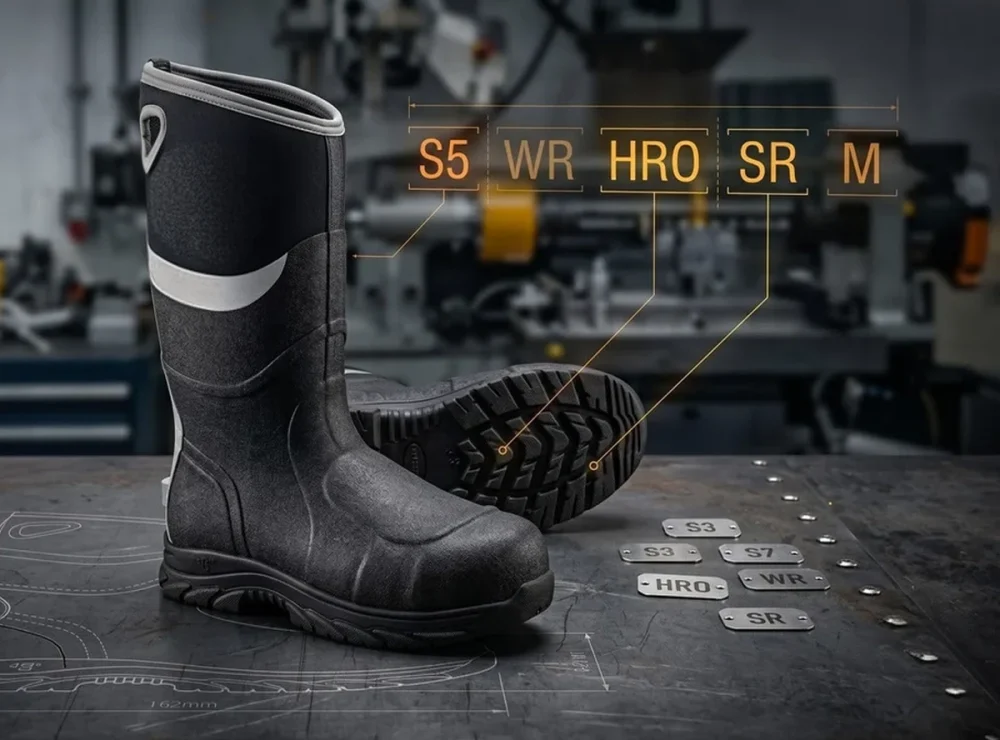
The letters stamped inside a safety boot (SB, S1P, S3, S7S and the rest) tell you exactly what the footwear has been tested to do. They come from BS EN ISO 20345, the standard for safety footwear. The standard was substantially revised in 2022. The changes affect puncture resistance, slip resistance and water resistance, and both old and new markings will be on shelves for some time. This guide decodes the categories, explains what changed and helps you match boots to the job.
The baseline: what every safety boot must do
Every safety boot or shoe certified to EN ISO 20345 has a protective toecap tested to 200 joules of impact and 15 kN of compression. Footwear with lower toecap protection falls under different standards: EN ISO 20347 for occupational footwear, which has no toecap requirement. A “safety” boot always has the 200 J toecap. The material can be steel, composite or alloy, as long as it passes the test.
Under the 2022 revision every category also has to pass a basic slip resistance test on a ceramic tile with a detergent (sodium lauryl sulphate) solution. Because this is now mandatory, it no longer needs its own code.
Safety footwear categories explained
SB: safety basic
SB is the minimum: the 200 J toecap and basic slip resistance. SB footwear may have an open back or be made from polymer (for example some wellingtons). Extra properties are added as separate codes, so an “SBP” boot is SB with puncture resistance.
S1: closed seat, antistatic, energy absorption
S1 adds a closed seat region (heel area), antistatic properties (A) and energy absorption in the seat region (E). S1 suits dry indoor work such as warehousing and light industry.
S1P, S1PL and S1PS: adding puncture resistance
S1P is S1 plus puncture resistance. The 2022 standard now distinguishes the type of midsole, shown by the suffix. See the puncture section below.
S2: water penetration and absorption
S2 is S1 plus resistance to water penetration and absorption of the upper (WPA, previously “WRU”).
S3: the outdoor all-rounder
S3 is S2 plus puncture resistance and a cleated outsole. It is the most common category on UK construction sites. Under the 2022 standard you’ll see S3, S3L or S3S depending on the puncture insert.
S6 and S7: whole-boot water resistance
The 2022 revision introduced two new categories. S6 is S2 plus WR, water resistance of the whole footwear tested as a complete boot. S7 is S3 plus WR, effectively a waterproof S3, available as S7, S7L or S7S. Look at S7 for groundworks, agriculture, utilities and other wet outdoor jobs.
Summary table: EN ISO 20345:2022 categories
| Category | Builds on | Adds | Typical use |
|---|---|---|---|
| SB | — | 200 J toecap, basic slip | Base level; often polymer boots |
| S1 | SB | Closed seat, antistatic (A), energy absorption (E) | Dry indoor work |
| S1P / S1PL / S1PS | S1 | Puncture resistance (metal / non-metal) | Warehouses, logistics, light industry |
| S2 | S1 | Upper water penetration and absorption (WPA) | Damp environments, catering |
| S3 / S3L / S3S | S2 | Puncture resistance, cleated outsole | Construction, outdoor sites |
| S6 | S2 | Whole-footwear water resistance (WR) | Wet work without puncture risk |
| S7 / S7L / S7S | S3 | Whole-footwear water resistance (WR) | Groundworks, utilities, agriculture |
What changed in EN ISO 20345:2022
Puncture resistance: P, PL and PS
Before 2022, any puncture-resistant midsole was simply “P”, tested with a 4.5 mm nail. The new standard separates three types:
- P: metal insert, tested with the 4.5 mm nail.
- PL: non-metal (textile/composite) insert, tested with the 4.5 mm nail (“L” for large).
- PS: non-metal insert, tested with a thinner 3.0 mm nail (“S” for small), the more demanding test.
Where sharp, thin objects such as screws, fine nails or rebar tie wire are common, PS (for example S1PS, S3S or S7S) gives the most reassurance from a non-metal midsole.
Slip resistance: SRA, SRB and SRC replaced by SR
The old SRA (tile/detergent), SRB (steel/glycerine) and SRC (both) codes have gone. Basic slip resistance on tile with detergent is now mandatory and unmarked. The optional SR marking shows the footwear has also passed an additional test on ceramic tile with glycerine, which is more representative of oily floors. Footwear marked with the Ø symbol hasn’t been slip tested. That is permitted only for specialist footwear, such as some studded boots.
Water resistance: WRU becomes WPA
The upper water resistance test is now coded WPA. The new WR whole-boot test is what defines S6 and S7.
Other new and changed codes
- FO (fuel oil resistant outsole) is now an optional extra rather than built into S1–S3.
- LG: ladder grip, for a defined heel and waist profile.
- SC: scuff cap, extra abrasion protection on the toe.
- Other common codes remain: HRO (heat-resistant outsole), CI/HI (cold/heat insulation), M (metatarsal protection), AN (ankle protection), ESD, which is tested to EN 61340 rather than EN ISO 20345, and CR (cut-resistant upper).
Old and new markings side by side
Footwear certified to EN ISO 20345:2011 remains on the market until its certificate expires. Older stock can therefore still be perfectly valid. As a rough guide:
- An old “S1P SRC” shoe is broadly comparable to a new “S1P SR” (metal insert) or “S1PL SR” (non-metal).
- An old “S3 SRC” boot with a composite midsole is broadly comparable to a new “S3L SR”, or “S3S SR” if it passed the 3 mm nail test.
- A boot with a waterproof membrane now has a test, WR, that proves it: S6 or S7.
Always read the full marking on the label or tongue rather than assuming.
Choosing the right category for the job
| Job / environment | Suggested minimum | Consider adding |
|---|---|---|
| Warehouse, picking, logistics | S1P / S1PL | SR, ESD where electronics are handled |
| Catering, food processing | S2 | SR, slip-on design |
| General construction | S3 / S3S | SR, HRO, ankle protection |
| Groundworks, utilities, farming | S7 / S7S | CI for winter, SR |
| Roofing, scaffolding, ladder work | S3 or S1P | LG ladder grip |
| Foundries, hot surfaces | S3 | HRO, HI, M |
Base the final choice on your risk assessment, as required by the PPE at Work Regulations. HSE guidance stresses that slip-resistant footwear should be trialled in the actual work environment (HSE: slips and trips).
Examples from our range
Browse safety boots, safety shoes, safety trainers and wellies and rubber boots. Examples include the Beeswift Hiker S7S composite boot, the Beeswift Hiker S3 composite boot and the Beeswift composite S1P shoe. For long shifts, good insoles can make a real difference. Kneeling trades should also read our knee pad guide.
FAQs
What is the difference between S1P and S3?
Both have a toecap, antistatic properties, energy absorption and puncture resistance. S3 adds a water-resistant upper (WPA) and a cleated outsole, making it better for outdoor and wet work.
What does S7 mean on safety boots?
S7 is a category introduced in EN ISO 20345:2022. It means S3 plus whole-footwear water resistance (WR), so it is effectively a tested waterproof S3 boot.
What is the difference between PL and PS?
Both are non-metal puncture-resistant inserts. PL is tested with a 4.5 mm nail; PS is tested with a thinner 3.0 mm nail, which is a more demanding test.
Has SRC slip resistance been replaced?
Yes. Under EN ISO 20345:2022, basic slip resistance is mandatory and unmarked. SR shows an additional pass on tile with glycerine. SRA, SRB and SRC no longer appear on new certifications.
Are boots certified to EN ISO 20345:2011 still legal?
Yes. Footwear with a valid certificate to the 2011 version can still be sold and used. Buyers should simply understand the different markings.
Does SB mean the boot has no slip resistance?
No. Under the 2022 standard all categories, including SB, must pass the basic slip test unless they are marked Ø.
Summary
Read the full marking, not just the “S” number. S1P for dry indoor work, S3 for most sites and S7 for wet ground cover most needs. Add PS for fine sharp objects, SR for oily floors and LG for ladders. See the full safety footwear range, or our guide to workwear vs PPE.
Sources: BS EN ISO 20345:2022 (BSI); HSE footwear guidance; uvex guide to EN ISO 20345:2022.