
7 standards · at a glance
PPE Standards Guide
Safety Standards Explained. Find the right protection class for your job, from hi-vis classes to S3 boots and cut-resistant gloves.
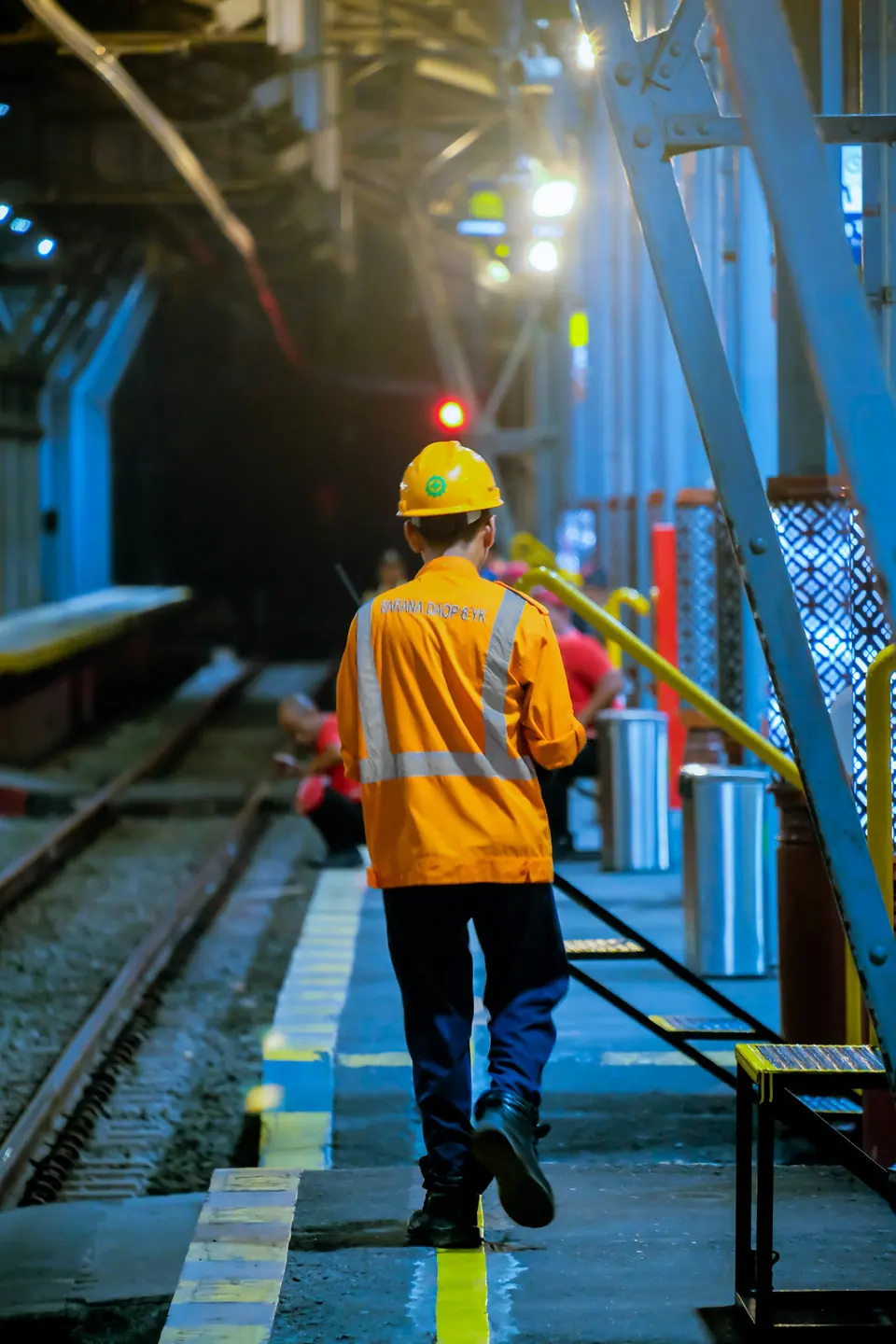
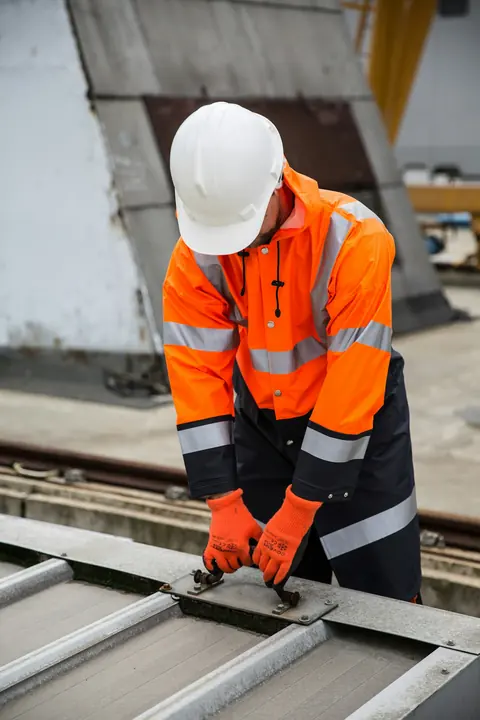
EN ISO 20471
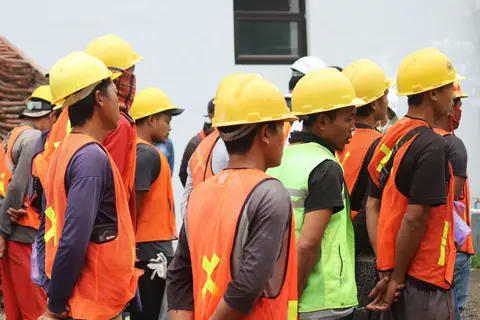
High-visibility clothing
Class = minimum visible area of fluorescent background and retroreflective tape. Class 3 is the highest.
- 1
Lowest level. For off-road work, or worn with a higher-class garment.
Environment
- Car parks, warehouses, yards
- Private roads and off-road sites
- Hi-vis trousers worn with a Class 2/3 top
Standards
- ≥0.14 m² fluorescent background
- ≥0.10 m² retroreflective tape
- Not enough on its own for road works
- 2
Standard hi-vis vests and many jackets. The minimum for road works under Chapter 8.
Environment
- Construction and logistics sites
- Work on or near A and B roads
- Delivery drivers, loading bays
Standards
- ≥0.50 m² fluorescent background
- ≥0.13 m² retroreflective tape
- Rail lineside: orange, Class 2 minimum (RIS-3279-TOM)
- 3
The most visible class. It must cover the torso and either the sleeves or the legs.
Environment
- Motorways and high-speed dual carriageways
- Airports and airside work
- Emergency response, poor light
Standards
- ≥0.80 m² fluorescent background
- ≥0.20 m² retroreflective tape
- Chapter 8: full-length sleeves on high-speed roads
- +
A Class 2 jacket worn with Class 1 trousers can be certified as Class 3, but only when the pair is tested together.
Environment
- Road and rail sites that require Class 3
- Two-piece workwear
Standards
- Both items must be certified together for the combined class
- Check the label for the combined rating
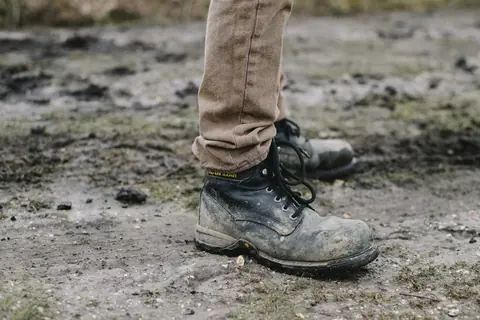
EN ISO 20345:2022
Safety footwear
Every class has a 200 J toe cap. The 2022 revision dropped SRA/SRB/SRC, added the SR and Ø slip markings, and split perforation resistance into P, PL and PS.
- SB
Toe protection plus the basic slip test. The base level for every safety shoe.
Environment
- Dry, low-risk indoor work
- Light warehousing
Standards
- 200 J toe cap
- Slip test on ceramic tile + detergent (no marking)
- SR = also passes ceramic + glycerine · Ø = not tested
- Fuel oil resistance is now optional (FO)
- S1
Adds an enclosed heel, antistatic soles and heel energy absorption. S1P adds a midsole that resists penetration.
Environment
- Warehouses, factories, logistics
- Dry indoor floors
- S1P: where sharp objects lie on the floor
Standards
- Closed seat region, antistatic (A)
- Heel energy absorption (E)
- S1P: perforation resistance P (metal) or PL / PS (non-metal)
- S3
S2 adds resistance to water penetration and absorption. S3 adds perforation resistance and a cleated outsole.
Environment
- Construction, groundwork
- Outdoor and damp conditions
- Agriculture, utilities
Standards
- Upper resists water (WPA)
- S3: perforation resistance + cleated sole
- S3L / S3S = non-metal midsole type
- S7
S4/S5 are moulded rubber or polymer boots (S5 adds perforation resistance and cleats). S6/S7 are S2/S3 with a fully water-resistant boot (WR).
Environment
- Wet work, drainage, food processing
- Wellington boots (S4/S5)
- Heavy rain and standing water (S6/S7)
Standards
- S4: antistatic, energy absorption, leak-proof
- S5: + perforation resistance + cleated sole
- S6 = S2 + WR · S7 = S3 + WR (new in 2022)
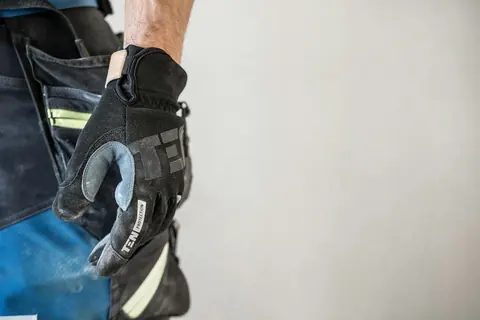
EN 388:2016
Protective gloves – mechanical
Marked as 4 digits followed by 1–2 letters, for example 4X43F P. Higher numbers or letters give more protection.
- 4
Abrasion 1–4, coupe cut 1–5 (X = not tested), tear 1–4, puncture 1–4, then ISO cut A–F and optional impact (P).
Environment
- General handling and construction
- Use it to compare gloves
Standards
- Abrasion · Cut (coupe) · Tear · Puncture
- ISO 13997 cut letter A–F
- P = impact protection passed
- A
For general handling with little exposure to sharp edges.
Environment
- Assembly, packing, warehousing
- Landscaping, general maintenance
Standards
- A: ≥2 N · B: ≥5 N (ISO 13997)
- C
For handling sharp but light materials.
Environment
- Glazing, sheet materials, plasterboard
- Light metalwork, recycling
Standards
- C: ≥10 N · D: ≥15 N (ISO 13997)
- F
The highest cut levels, for sharp metal and glass.
Environment
- Sheet metal and glass handling
- Automotive, demolition, blades
Standards
- E: ≥22 N · F: ≥30 N (ISO 13997)
EN 343:2019
Protection against rain
Two ratings: water penetration (class 1–4) and breathability (class 1–4, by Ret in m²·Pa/W). Class 4 is the best for both.
- 1
The lowest class. Class 1 breathability means wear time should be limited.
Environment
- Short spells outdoors
- Light drizzle
Standards
- Water: ≥8,000 Pa (fabric and seams, before pre-treatment)
- Breathability: Ret > 40 (limited wear time)
- 2
Suitable for typical changeable UK weather.
Environment
- Site visits, deliveries
- Intermittent rain
Standards
- Water: fabric ≥8,000 Pa after pre-treatment
- Breathability: 25 < Ret ≤ 40
- 3
Good waterproofing and breathability for long days outdoors.
Environment
- All-day outdoor work
- Construction, utilities
Standards
- Water: ≥13,000 Pa (fabric after pre-treatment)
- Breathability: 15 < Ret ≤ 25
- 4
The highest class, with seams also tested after pre-treatment.
Environment
- Highways, rail, marine
- Long shifts in heavy rain
Standards
- Water: ≥20,000 Pa incl. seams after pre-treatment
- Breathability: Ret ≤ 15
- R = whole garment rain-tower tested (X = not)
ISO 11612 / IEC 61482-2
Flame retardant & arc flash
ISO 11612 covers heat and flame. IEC 61482-2 covers electric arc thermal hazards.
- A
A1/A2 limited flame spread. B (1–3) convective heat. C (1–4) radiant heat.
Environment
- Petrochemical, oil & gas
- Utilities, industrial plants
Standards
- A1 / A2 limited flame spread
- B1–B3 convective heat
- C1–C4 radiant heat
- D
D molten aluminium, E molten iron, F contact heat, each rated 1–3.
Environment
- Foundries, smelting
- Metal casting
Standards
- D1–D3 molten aluminium splash
- E1–E3 molten iron splash
- F1–F3 contact heat
- 1
Tested with the IEC 61482-1-2 box test at 4 kA.
Environment
- Low-voltage electrical work
- Panel and switchgear maintenance
Standards
- APC 1 (4 kA box test)
- Often also has an ATPV / ELIM rating in cal/cm²
- 2
Higher box-test class. Choose by risk assessment, using the ATPV/ELIM cal/cm² rating.
Environment
- Higher-energy electrical work
- Distribution networks
Standards
- APC 2 (7 kA box test)
- Open-arc ATPV / ELIM in cal/cm² (IEC 61482-1-1)
EN 166
Eye protection
Frame and lens markings show optical class, impact strength and fields of use.
- S
A step up from minimum robustness. Common on standard safety spectacles.
Environment
- General site work, DIY
- Light workshop tasks
Standards
- Optical class 1–3 (1 = best)
- S: 22 mm, 43 g steel ball at ~5.1 m/s
- F
High-speed particle impact: F low energy (45 m/s), B medium (120 m/s, goggles/faceshields), A high (190 m/s, faceshields only).
Environment
- Grinding, drilling, cutting
- Machining
Standards
- F 45 m/s · B 120 m/s · A 190 m/s (6 mm ball)
- T = also tested at −5 °C and +55 °C
- 3
Field-of-use codes, normally on goggles and faceshields.
Environment
- Chemical handling (3)
- Dusty work (4), gas and fine dust (5)
Standards
- 3 droplets/splashes · 4 large dust
- 5 gas & fine dust
- K
Lens coatings and specialist protection.
Environment
- Long wear, humid sites (N)
- Electrical (8), molten metal / hot solids (9)
Standards
- K anti-scratch · N anti-fog
- 8 short-circuit arc · 9 molten metal & hot solids
EN 352
Hearing protection
Chosen by SNR (dB), which should bring the noise at the ear to roughly 70–80 dB. UK action levels are 80 and 85 dB(A).
- 1
Over-ear muffs that are quick to put on and take off.
Environment
- Intermittent noise
- Sites, workshops
Standards
- SNR in dB on the packaging
- H / M / L frequency values
- 2
Disposable or reusable plugs.
Environment
- Continuous noise, long shifts
- Hot environments
Standards
- SNR in dB
- Disposable or reusable
- 3
Earmuffs that clip onto a safety helmet.
Environment
- Construction with a hard hat
- Forestry
Standards
- Tested with the specific helmet models listed
This is a summary for guidance only. Always check the product label, the declaration of conformity and your risk assessment.
Not sure which class you need?
Tell us the job and the site rules and we’ll point you to compliant kit.
- Same-day dispatch by 1pm
- Free UK delivery over £149
- Proof before print