On this page
Cut-resistant gloves are rated under EN 388:2016+A1:2018, the European standard for protective gloves against mechanical risks (also published internationally as ISO 23388). The marking can be confusing. A glove might be labelled “4X43D” or “2544F”, and older stock is still sold as “cut level 5”. Glove cut levels explained simply: this guide covers what each digit and letter means, why the ISO A–F letter has replaced the old coup test number as the reliable cut rating, and which cut level suits which job.
Reading the EN 388 shield
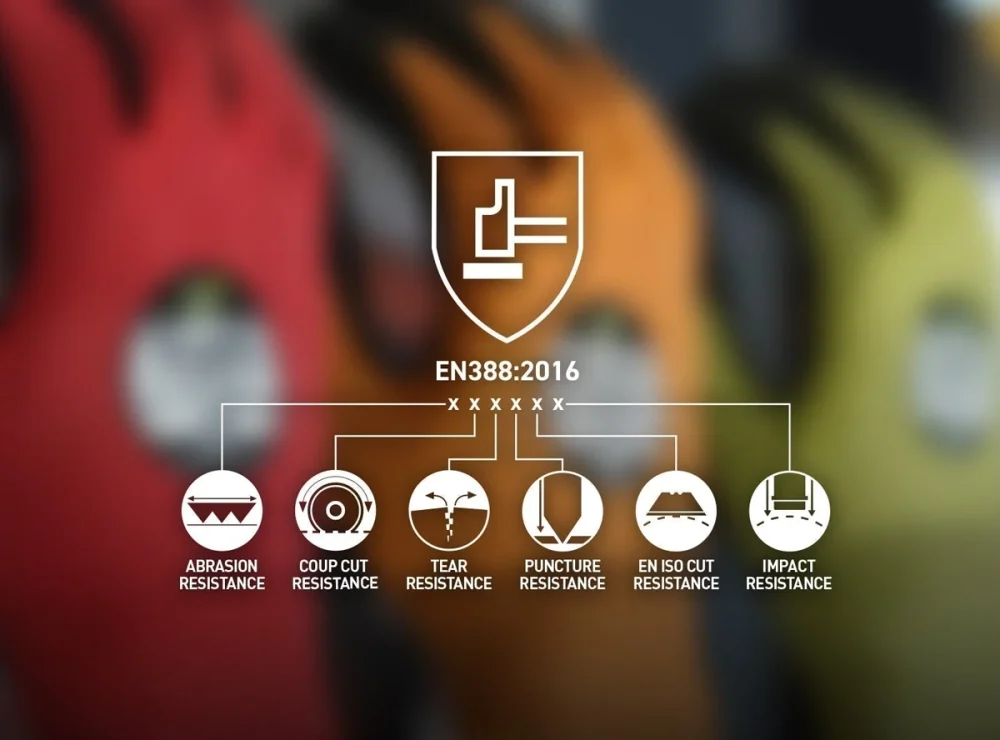
EN 388 gloves carry a shield pictogram with up to six characters underneath. Each position is a different test:
| Position | Test | Scale |
|---|---|---|
| 1 | Abrasion resistance | 0–4 |
| 2 | Cut resistance – coup (circular blade) test | 0–5 or X |
| 3 | Tear resistance | 0–4 |
| 4 | Puncture resistance | 0–4 |
| 5 | Cut resistance – ISO 13997 (TDM) test | A–F or X |
| 6 | Impact protection (optional) | P if passed |
An X means the test was not carried out or isn’t applicable, and a 0 means the glove was tested but fell below level 1. So “4X43D” means abrasion 4, coup not applicable, tear 4, puncture 3 and ISO cut level D.
Coup test numbers vs ISO A–F letters
The coup test (1–5)
The coup test uses a rotating circular blade moving back and forth over the sample under a fixed load. The result is an index, banded from level 1 to level 5. It has been used for decades, which is why “cut level 5” is still a familiar phrase.
The problem is that high-performance fibres such as HPPE, glass and steel blends blunt the blade during the test, which gives unreliable, often inflated, results. Under the 2016 revision, if the blade dulls during the coup test, the coup result is only indicative and the ISO 13997 result becomes the reference cut rating. That is why many modern cut gloves show an “X” in position two.
The ISO 13997 TDM test (A–F)
The TDM (tomodynamometer) test draws a straight blade once across the material under increasing loads. It measures the force in newtons needed to cut through over a fixed stroke length. It is more repeatable and better reflects real slicing hazards. The results are graded by letter:
| ISO cut level | Minimum cut force | Protection level |
|---|---|---|
| A | 2 N | Low |
| B | 5 N | Low–moderate |
| C | 10 N | Moderate |
| D | 15 N | Medium–high |
| E | 22 N | High |
| F | 30 N | Very high |
Why “cut 5” and “cut F” are not the same
There is no exact conversion between the two scales. A glove that scored coup level 5 might only reach ISO B or C, or it might reach E or F, depending on the fibre. When comparing gloves, use the letter. Where a supplier only quotes a coup number (for example “cut level 5”), check the product’s full EN 388 marking or ask for the ISO 13997 result.
Other EN 388 ratings that matter
- Abrasion (1–4): cycles of sandpaper abrasion before a hole appears. This matters for durability when handling rough materials such as blocks and timber.
- Tear (1–4): force needed to tear the material. This matters around machinery and sharp edges that snag.
- Puncture (1–4): resistance to a standard stylus, similar to a nail. This is not needlestick protection. Hypodermic needles are finer, and needlestick gloves are tested separately (for example to ASTM F2878).
- Impact (P): knuckle and back-of-hand protection, tested to EN 13594 methods. It is shown as a “P” in sixth position when passed. See our impact-resistant gloves.
Which glove cut levels for which job?
The Personal Protective Equipment at Work Regulations require PPE to be suitable for the risk, so choose from your risk assessment. HSE’s guidance on gloves also stresses fit, dexterity and the wearer’s ability to do the task (HSE: choosing the right gloves). Overspecifying cut protection can reduce dexterity and grip, which brings risks of its own.
| Typical task | Suggested ISO cut level | Notes |
|---|---|---|
| General handling, assembly, picking, light maintenance | A–B | Prioritise dexterity and grip |
| Construction, bricklaying, handling timber and plasterboard | B–C | Good abrasion score important |
| Handling sharp-edged sheet, cables, ducting, plumbing | C–D | Look for tear 4 |
| Glazing, sheet metal, automotive pressings, recycling | D–E | Consider sleeve protection |
| Glass handling, metal stamping, blade changing | E–F | Highest cut forces; check grip coating |
| Food processing with knives | D–F (food-contact approved) | Mesh gloves for the non-knife hand where specified |
No glove is “cut-proof”. Even level F can be cut by a powered blade or a heavy enough slice. Gloves are the last line of defence after guarding and safe systems of work. Gloves must never be worn near rotating machinery such as drills or lathes where they could be caught.
Coatings, gauge and comfort
Cut level is only half of the choice. The coating sets grip: nitrile for oily conditions, foam nitrile for breathability, PU for fine dexterity and latex for grip on dry rough surfaces. The gauge sets thickness: an 18-gauge knit is thinner and more dexterous than a 13-gauge. For winter outdoor work, see our article on why thermal work gloves are essential and our cold and thermal gloves.
Examples from our range
Browse all cut-resistant gloves, general work gloves and the full hand protection range. Examples include the Glovezilla HPPE 18 gauge Cut F gloves, the Glovezilla HPPE 18 gauge Cut E gloves and the Glovezilla waterproof nitrile Cut D gloves. Always check the full EN 388 marking on each product before you choose.
Looking after cut gloves
- Inspect them before each use for holes, worn coating or broken fibres, and discard damaged pairs.
- Follow the manufacturer’s washing guidance. Some gloves can be laundered without losing performance, others can’t.
- Issue the right size. Loose gloves reduce dexterity and are more likely to snag.
FAQs
What is the highest cut level in EN 388?
Under EN 388:2016+A1:2018 the highest ISO 13997 cut level is F, which needs at least 30 newtons to cut. On the older coup scale the top level is 5.
Is cut level 5 the same as cut level F?
No. They come from different tests and there is no direct conversion. A coup level 5 glove could achieve anything from ISO B to F, so compare gloves using the letter.
What does X mean on a glove rating?
X means the test was not performed or isn’t applicable. On cut gloves, an X in the second position often means the coup test was unreliable because the blade blunted, so the ISO letter is the valid cut rating.
What cut level do I need for construction?
Most general construction tasks are well served by ISO cut level B–C, rising to D or higher for sheet metal, glazing or other sharp-edged materials. Confirm the level with your risk assessment.
Do cut-resistant gloves protect against needles?
Not necessarily. The EN 388 puncture test uses a blunt stylus, not a fine needle. Use gloves specifically tested for needlestick resistance where sharps are a risk.
Summary
Read the shield from left to right: abrasion, coup cut, tear, puncture, ISO cut, impact. Use the A–F letter to compare cut protection, match the level to the task, and don’t sacrifice dexterity by overspecifying. For help equipping a team, read our guide to buying workwear and PPE for a growing workforce.
Sources: BS EN 388:2016+A1:2018 (BSI); HSE glove guidance; uvex: safety glove standards.